Tuesday, May 23, 2017


'things and nothings' 

Art Exhibition 
by
Kelvin Haizel

9. 5.17 - 27. 5. 17

Old KNUST Museum 


“Things and Nothings” is a result of investigations into the image (still and moving). A thing is considered a thing because it has yet to enter any form of categorization outside of being a thing; it has yet to be classified. However, nothing is already classified among the sub (-stitute) (-altern) (-standard) it may be considered as inferior, derogatory and or lowly within a certain hierarchy of objects. In another breath the image as nothing may be thought of as not-special, banal or even mundane. In the world saturated with all sorts of images, we could experience them in their material form as objects that are things or nothings. How do the transitions from images to objects occur?  What is the object of an image? How can we tell things from nothings? Using a body of work produced over the past two years, I present the image (in both still and moving form) and the objects they become. 


images from the exhibition, courtesy the artist and Leonphotos.


b.1987. Kelvin Haizel investigates the contemporary condition of the image, in photographic and video form, and its manifestations as objects. He lives and works in Ghana.


kindly visit  https://iubeezy.wordpress.com/2017/05/23/notes-on-haizels-things-and-nothings/for a review on the exhibition by IUB.


Friday, August 26, 2016

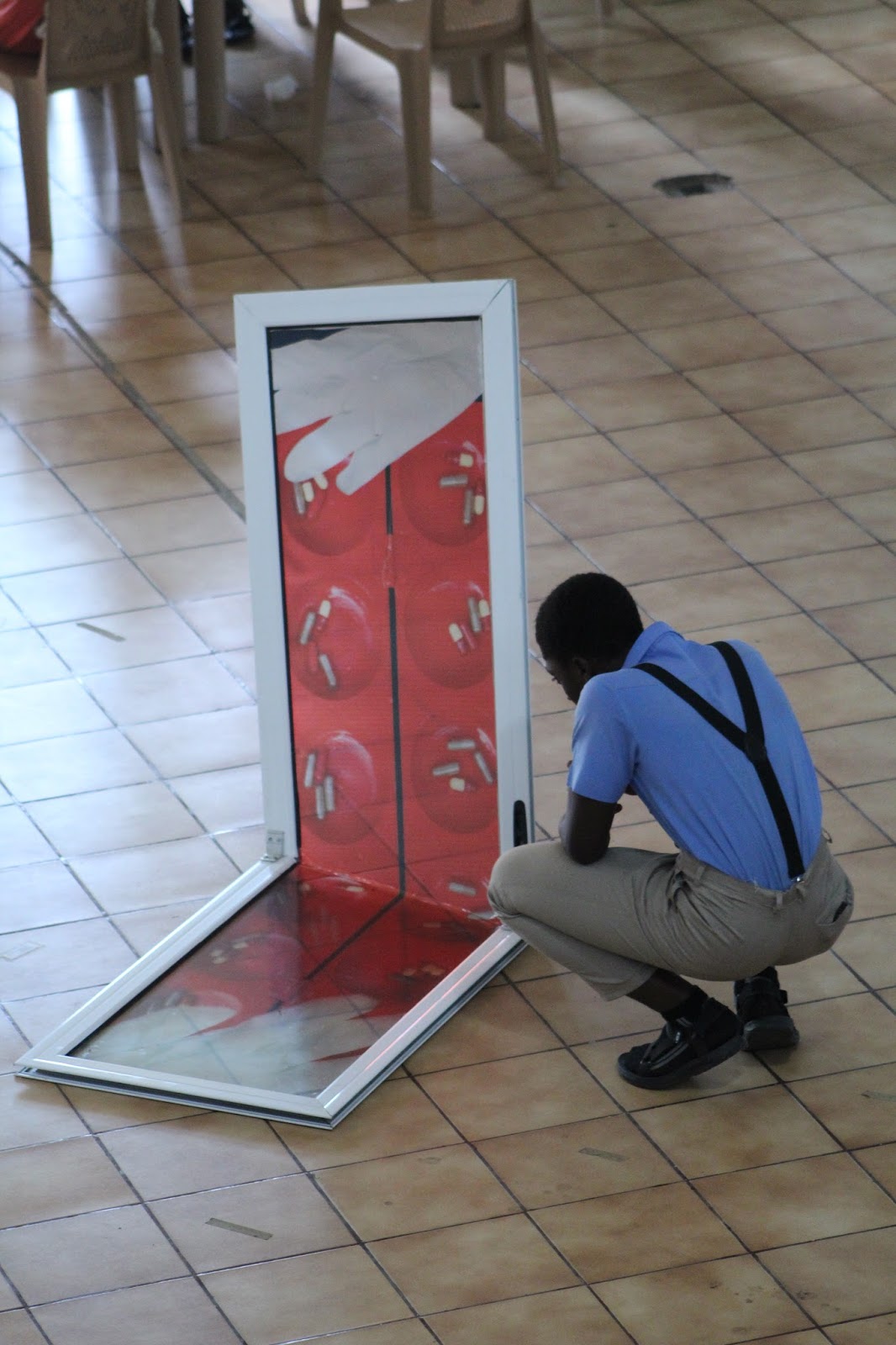
Who puts a bent glass door on the museum floor as art?


"Untitled"1 (one among many obects). Installation view. Museum of Science and Technology. 2016. 
Photo credit: Bernard Akoi-Jackson

Who puts a bent glass door on the museum floor as art? This question has a sarcastic curiosity to it; and one might be equally ridiculous and say 'Kelvin Haizel'. But inherent in that question is also the search for meaning; what is this? While going through a number of images from the exhibition,i could project this question unto one of the blue boys who visited the museum of science and technology, during the Cornfields in Accra art exhibition. He sat on his heels next to the [un]familiar object and keenly observed.
I wonder, What might he have thought?
The label next to it doesn't point to anything outside of the object either: It reads "Untitled"1 (one among many objects). 'Where is/are the clue(s) to unpack this? Could it be in the phenomenological experience? Or in its materiality? Perhaps the various layers of artisanal and industrial processes might offer something here. How about the seemingly recognizable image of drugs accompanied by surgical gloves? But come to think of it, if its a door, then might it have some relationship to architecture? Why is it detached and made to sit on the bare floor? Was it ever attached to any structure in the first place? The rollers in the dents suggest they might have been! If so why is it unhinged? Has it moved from one place to another? Will it move from here to another? well there seem to be so many questions.
To begin with its specific physical and social properties, it is recognizable as a door with a sticker on it. The point of departure from identifying it as what we might know it has to do with function. A door in its simplest function is what opens you into or out of a building. Usually hinged to the frame of the building; it occupies a position between an entry and exit, it is neither outside nor inside, it only mediate the two spaces. When it is unhinged, it no longer bear its function, it is no longer a door, it becomes an object among many. By removing its function which is associated with design the object enters into the realm of art. In other words, it decouples itself from usefulness and asserts its position as a pure form entering into the realm of aesthetics. Boris Groys writes "In the art context to aestheticize the things of the present means to discover their dysfunctional, absurd, and unworkable charactor...the goal of design is to improve the status quo -- to make it more attractive. Art also accepts the status quo -- but it accepts it as a corpse, after its transformation into a mere  representation." To align my thoughts with Groys', if we consider the object at the exhibition as a door, then we only do so in acceptance of it as corpse. On the other hand, if we engage with it as an object that shares the literal space with all other objects (as it has been installed in the museum) then it opens up the collective subjectivity of meaning making. The dysfuntional and desacralized object further enters into the politics of the now shared space -- the ground.
These concerns will be expanded in my subsequent posts, but for now, let's journey through the exhibition with blueboy.
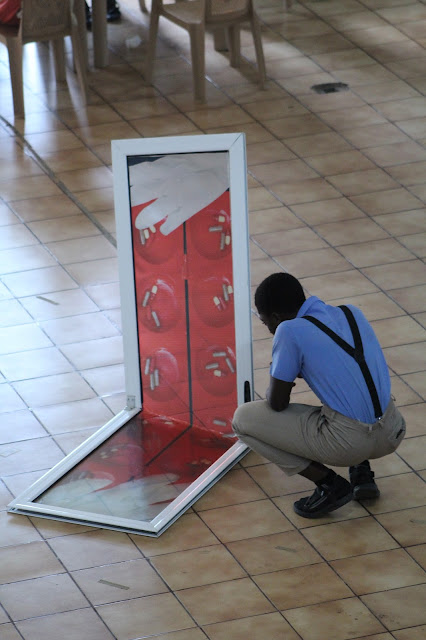
"Untitled"1 (one among many objects). Installation view. Museum of Science and Technology. 2016. 
Photo credit: Bernard Akoi-Jackson

'O, snap! This video and that first work share something in common. Ahhhh...it is a an oware board with pills as the members to play with. Well whatever! I can't stand here all day watching the entire game. I need to go see all the other interesting stuff too.' 


Just when he straps his bag, Selorm Kudjie (one of the curators) come by. 'Ok let me listen to this curator for a min. He might know what this work means. His rasta though! Ei! I here he is an Odade3 oo.'


The same artist had this other installation at the top of the atrium as well. A 12 channel video projection that temporarily converts the glass screens -- through which natural light enters the atrium -- into a sort of moving stained glass. The rigid glass screens are covered with flaccid paper-fusing to make the reverse projection seen from the inside. And yes I realized the oware game that i already know is here dematerialized in this video form and rematerialized in the many monumental and object form through the projection, screened on television or as photographic stills on defunctionalized glass door. what is all this koraa aah!


"A thing about Forevers" (12 channel video projection at the museum of Science and Technology) 5min 45sec video loop  Installation view from outside. Museum of Science and Technology. 2016. Photo credit: Kelvin Haizel

#blaxTARLINES   #Cornfieldsinaccra  #sultanhaizel   #kelvinhaizel

Who puts a bent glass door on the museum floor as art?


"Untitled"1 (one among many obects). Installation view. Museum of Science and Technology. 2016. 
Photo credit: Bernard Akoi-Jackson

Who puts a bent glass door on the museum floor as art? This question has a sarcastic curiosity to it; and one might be equally ridiculous and say 'Kelvin Haizel'. But inherent in that question is also the search for meaning; what is this? While going through a number of images from the exhibition,i could project this question unto one of the blue boys who visited the museum of science and technology, during the Cornfields in Accra art exhibition. He sat on his heels next to the [un]familiar object and keenly observed.
I wonder, What might he have thought?
The label next to it doesn't point to anything outside of the object either: It reads "Untitled"1 (one among many objects). 'Where is/are the clue(s) to unpack this? Could it be in the phenomenological experience? Or in its materiality? Perhaps the various layers of artisanal and industrial processes might offer something here. How about the seemingly recognizable image of drugs accompanied by surgical gloves? But come to think of it, if its a door, then might it have some relationship to architecture? Why is it detached and made to sit on the bare floor? Was it ever attached to any structure in the first place? The rollers in the dents suggest they might have been! If so why is it unhinged? Has it moved from one place to another? Will it move from here to another? well there seem to be so many questions.
To begin with its specific physical and social properties, it is recognizable as a door with a sticker on it. The point of departure from identifying it as what we might know it has to do with function. A door in its simplest function is what opens you into or out of a building. Usually hinged to the frame of the building; it occupies a position between an entry and exit, it is neither outside nor inside, it only mediate the two spaces. When it is unhinged, it no longer bear its function, it is no longer a door, it becomes an object among many. By removing its function which is associated with design the object enters into the realm of art. In other words, it decouples itself from usefulness and asserts its position as a pure form entering into the realm of aesthetics. Boris Groys writes "In the art context to aestheticize the things of the present means to discover their dysfunctional, absurd, and unworkable charactor...the goal of design is to improve the status quo -- to make it more attractive. Art also accepts the status quo -- but it accepts it as a corpse, after its transformation into a mere  representation." To align my thoughts with Groys', if we consider the object at the exhibition as a door, then we only do so in acceptance of it as corpse. On the other hand, if we engage with it as an object that shares the literal space with all other objects (as it has been installed in the museum) then it opens up the collective subjectivity of meaning making. The dysfuntional and desacralized object further enters into the politics of the now shared space -- the ground.
These concerns will be expanded in my subsequent posts, but for now, let's journey through the exhibition with blueboy.

"Untitled"1 (one among many objects). Installation view. Museum of Science and Technology. 2016. 
Photo credit: Bernard Akoi-Jackson

'O, snap! This video and that first work share something in common. Ahhhh...it is a an oware board with pills as the members to play with. Well whatever! I can't stand here all day watching the entire game. I need to go see all the other interesting stuff too.' 


Just when he straps his bag, Selorm Kudjie (one of the curators) come by. 'Ok let me listen to this curator for a min. He might know what this work means. His rasta though! Ei! I here he is an Odade3 oo.'


The same artist had this other installation at the top of the atrium as well. A 48 channel video projection that temporarily converts the glass screens -- through which natural light enters the atrium -- into a sort of moving stained glass. The rigid glass screens are covered with flaccid paper-fusing to make the reverse projection seen from the inside. 


#blaxTARLINES   #Cornfieldsinaccra  #sultanhaizel   #kelvinhaizel

Tuesday, September 1, 2015

The Optimist
One of my favorite tracks I listen to almost on the daily is "The Pessimist (feat. J. Cole)" on Wale's third studio album titled"The Album About Nothing".  In the intro, Jerry tells George "Oh so there is still hope?", and George responds saying "I don't want hope, hope is killing me. My dream is to become hopeless. When you're hopeless, you don't care, and when you don't care, that indifference,it makes you attractive."
I find this conversation intriguing, depending on the logic that to dream is to wish something into your existence, and to wish, is to hope (that which you wish) into existence. Thus, paradoxically all that George is saying is hoping to be hopeless. However his genuine concern  for hoping to be hopeless is what fascinates me. He states that hope is killing him. How can the only factor (hope) be your very nemesis? Unless dying is what you hope for. I think when we hope for something, we want it manifest in our existential realities. It might just be a fantasy, or in dire situations, the very bed rock on which one's life is anchored. Can you afford to be hopeless in such a situation as the latter? In my 28 April years, my experience tells me that, such prolonged hope is also likely to morph into desperation. Thus, characterized by a state of hopelessness; which has as its only antidote to be hope.

Do you continue to hope even though the condition seems hopeless? Do you  continue to hope at the expense of being taken advantage off?  Will you rather hope to be hopeless?

The photographs under the series "Get well soon" are taken from staged installations, using all the medicine (both orthodox and traditional) collected form a very close relation, as well as re-staging of some healing rituals that had to be performed over the past 27 years.
This body of work is essentially about a family's hope; which has prolonged to the extent of desperation. And as the woes of desperation may have it, it's opened up the doors to exploitation. But continues to hope that one of these days, the solution will arrive.


“Olive and Green are opposing harmonies” 
Digital photograph 29.55 x 49.28 in.  2015
©Kelvin Haizel

“...and none of the drugs and rituals affected the red chair"
Digital photograph 29.55 x 49.28 in.  2015
©Kelvin Haizel

"Come aaaaaaaaaaaaaaaaawt! I"
Digital photograph 29.55 x 49.28 in.  2015
©Kelvin Haizel

 "Come aaaaaaaaaaaaaaaaawt! II"  
Digital photograph 29.55 x 49.28 in.  2015
©Kelvin Haizel


"Chinese foƆ Abibiduro"
Digital photograph 29.55 x 49.28 in.  2015
©Kelvin Haizel

“A bit of everything reflected” 
Digital photograph 49.28 x 29.55 in.  2015
©Kelvin Haizel

Monday, August 17, 2015


“Get well soon” Kelvin Haizel ©2015

The power was out and the room was even darker with the indigo bed sheet, so I went to bed early. While I slept deeply I felt the phone vibrate from under my pillow. I picked the call but could barely hear a word. After 22seconds the connection got terminated. The time was 22:41pm on Sunday 16th august 2015. The vibration came through again at 22:42pm for 2minutes and this time I could hear his frail voice; “aaare yu awake? Yes Paa, I responded. He went on, “would you call me back after some time, my voice seems to be leaving me, and it feels finished”. Suddenly I felt cold and my palm and feet wouldn’t stop oozing sweat either. I kept turning in bed for the next two hours thinking of the worse but hoping for the best simultaneously.
 I called back after sometime. My phone records tell me; 00:48 Cancelled Call, 00:48 Cancelled Call 00:49 Cancelled Call
My heart kept pounding as I turned in bed more frequently in the now pool of sweat.  The phone vibrated again for the last time in the dark hours of this daunting morning. 01:00 Incoming call. He said in a rather assuring tone of voice this time, “sorry I the phone was on charge. I’m better now. I needed to know if my speaking ability is still there.”  My response was “that’s good to know”. He said “good night then, may the lord watch over you”. 

"Untitled:get well soon I" 
Digital photograph 49.28 x 29.55 in.  2015
©Kelvin Haizel

 "Untitled:get well soon II" 
Digital photograph 49.28 x 29.55 in.  2015
©Kelvin Haizel

"Untitled:get well soon III" 
Digital photograph 49.28 x 29.55 in.  2015
©Kelvin Haizel

Wednesday, June 3, 2015

[Is]The Body of C[h]ris[t]is in C[h]ris[t]is [?]


[Is]The Body of C[h]ris[t]is in C[h]ris[t]is [?]

Title of my three(3) days exhibition that lasted from 28th to 30th May 2015; at the newly constructed residential facility named Matha's Precinct. Designed by Incept Architectural Consult.

The title of my installation breaks down into two questions and two hypothetical statements from which the entire installation  sought to invite perspectives. The conversation is still ongoing even after the show and will be sustained for more positions and counter positions from all interested in the subject of African belief systems; pre-Arab invasion, subsequent Christian doctrine and contemporary religious practices. 

Is the body of Christ in Crisis?
Is the body of Crisis in Christ?

The body of  Christ is in Crisis.
The body of Crisis is in Christ.


You may contribute by dropping your comments.   


All images courtesy Bernrd Akoi-Jackson

Tuesday, May 19, 2015

"Colour doesn't ruin the party,...does it? or warded off just in case!"


 "Colour doesn't ruin the party,...does it? or warded off just in case!"

stills from  
"Untitled: A seemingly useless journey"


by 

Kelvin Haizel
2015


Archive of Experiences(2022)

Solo Exhibition at the MARKK Museum, Hamburg on occasion of the 8 th Hamburg Photography Triennial. This project reimagines an archival albu...