Lagos Biennial: Introducing yet Another platform for Visibility…
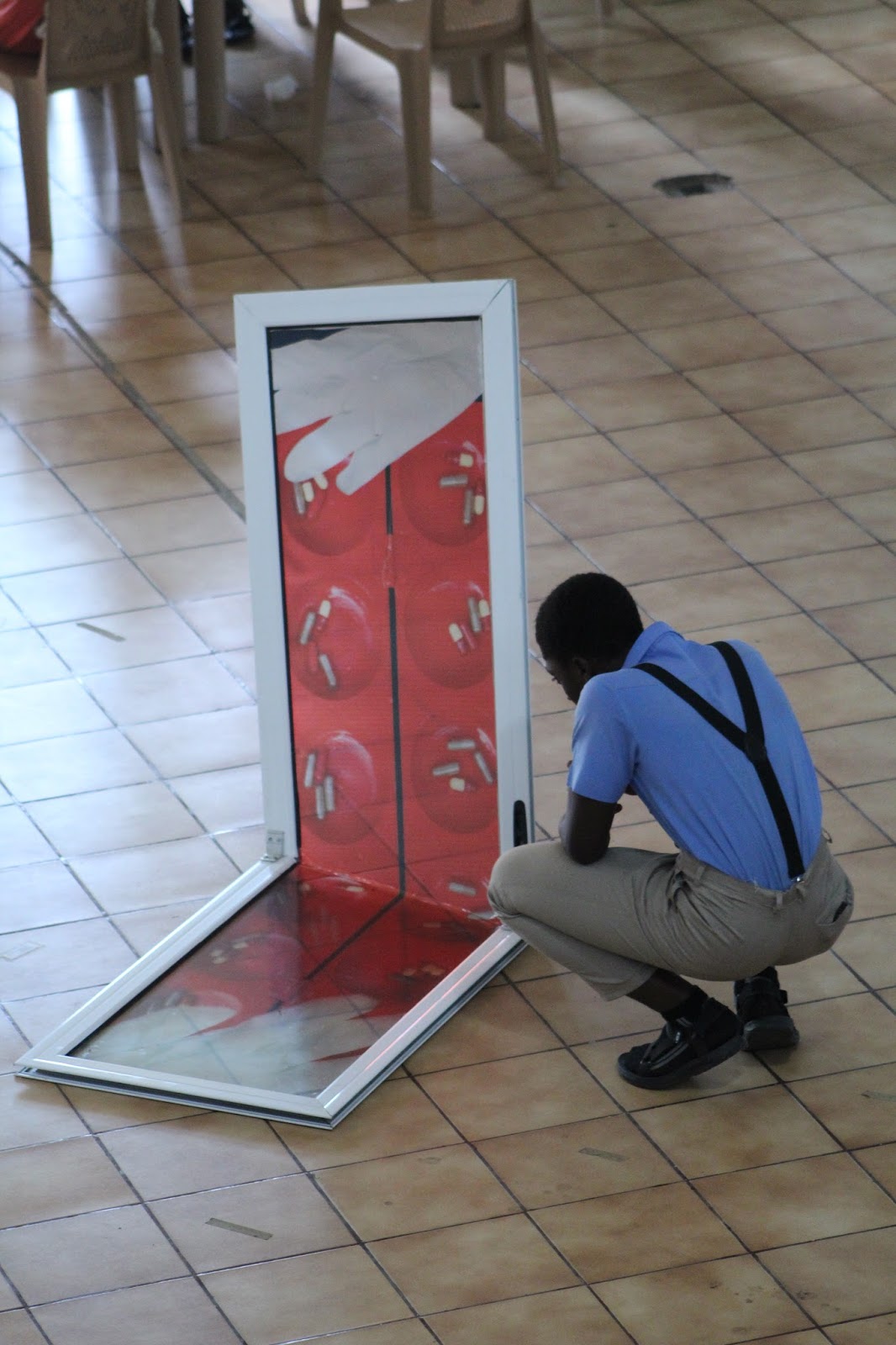
Kelvin Haizel "Yaw Crossing Liar". Lagos. 2017. Image courtesy Kelvin Haizel.
The maiden Lagos Biennial with the theme: “Living on the Edge” is one more biennial on the African continent. And another in the world of biennials. Lagos Biennial provides artists another opportunity to exhibit, and consequently stay visible or become visible, if they are emergent. This is what brought 41 artists from all over the world (Cuba, Ghana, Germany, South Korea and more), to show their work in Lagos, Nigeria from 12th October to 22nd November 2017.
In this world-wide game of visibility, an artist who does not exhibit does not exist and therefore risks invisibility. It is therefore a welcome gesture to have Folakunle Oshun and his dedicated team, initiate this audacious project. Even more importantly, as an artist-initiated and run biennial, the Lagos Biennial joins the likes of artist-run biennials such as the London Biennial, founded in 1998 by the conceptual artist David Medalla, the Dallas Biennial, established by Dallas-based artists Michael Mazurek and Jesse Morgan Barnett, the Kochi-Muziris Biennial founded in 2012 by the Kochi-Muziris Biennial Foundation with Bose Krishnamachari and Riyas Komu as artistic director and curator respectively, among others. Since its inception, the Kochi-Muziris Biennial has been curated by artists. Also curated by artists, the Lagos Biennial exemplifies an evolving trend of artists assuming the role of curator and charting a discourse of contested power relations between artists and ‘professional’curators, to wit. We can cite a few more examples: the 2017 Istanbul Biennial curated by Scandinavian artist duo Elmgreen & Dragset and the 2016 edition of the Shangai Biennale which was curated by the Raqs Media Collective.
In Rancièran thought, political activity emerges when whatever had no business being seen in the normalized order of things, is, by means of antagonism, what he terms as “dissensus”, made visible. [i] It is safe then to say that the intended outcome of artistic interventions, albeit within the field of curating, so long as it is motivated by political action, is to affect visibility or some sort of attention. What is the Lagos Biennial’s relationship to this politics of visibility? What does it mean in the face of purported in-visibility, if there are not many avenues or means by which practitioners will want to gain visibility? These questions may not be answered in this current take, but they can provide some amount of food for thought.
For an international event like the maiden edition of the Lagos Biennial which is heavily underfunded (if any real funding even came at all), the most important reason to organize it would be to offer yet another platform; another “alternative space” that should eventually provide visibility to artists. Here, they (the artists and organizers) can exercise their politics, engender debates and arouse scathing critique where necessary. It potentially creates an avenue for possible disruption of systems in place (if there even are any such systems in the very first place). The type of systems I refer to will be what Rancière calls the ‘police’; that which authorizes what becomes sensible; perceivable via the sensory faculties of human. Most people would like to equivocate the sensible in Rancièrean terms, with the visible. Sensibility in this regard according to the Rancièrean scheme, is much more complex.
Traditionally or in the ‘Ethical Regime’, large-scale exhibitions are organized by institutions with heavy budgets, and often led by a ‘significant’ curator. The curator would develop a curatorial interest and select artists/participants whose work often revolve around the curatorial imperative or direction. In this vein, a certain power dynamic is established amongst the parties involved: the institution, the curator, and the artist/participants. In this dynamic, the institution silently wields power so far as it is the source of funding or has the means of bank-rolling the event, the curator is revered as an arbiter of meaning and therefore indispensable in this relation (sometimes the task of sourcing for funding also falls within the gamut of the curator), the artist/participant, quite like the artworks, is usually one among the many who can be easily validated or disposed of, should any crisis be imminent. There seems to be an infinite pool of ‘a reserve army’ of artists at the beck and call of curators. Thus, the visibility gained by artists through such exhibitions is often that which is already sanctioned by the ‘police order’. An attempt to challenge this status quo is what grants credence to the intent of such platforms as the Lagos Biennial. But since it is only in its founding year yet, this has to stand the test of time. Sustainability is crucial if Lagos Biennial will become significantly viable in the world of so many biennials. And this sustainability would have to remain hinged onto the initial stance of nurturing patronage and support locally.
The Lagos Biennial by being one that is initiated, run and curated by artists, joins that rare crop of large-scale exhibitions that challenge the traditional order to several extents. One only need look further down the West-African coast to Ghana and study the efforts of blaxTARLINES KUMASI (Project Space for Contemporary Art in the Department of Painting and Sculpture, Kwame Nkrumah University of Science and Technology)[ii]. It is through experience gained from having been involved in the communally driven strategies of blaxTARLINES KUMASI, that my colleague Kwasi Ohene-Ayeh and I took the honour to contribute our quota to the Lagos Biennial as guest curators. When artists organize, fund and curate their own exhibitions, its intent is to cause a disruption in the normal order. As a result, another kind of visibility may be created. The publics and sensibilities that are activated pose new challenges and the type of complacency that the Ethical Regime produces is shattered. In this sense, there is real potential for transformation to be effected. But to really assess the verve of this biennial, we would have to bid time; allow it to grow, ensure its sustainability and make it work beyond the initial edition or subsequent two or three. How do we ensure this? Following from the professed interest of the biennial to “highlight the problems of the marginalized… and to critique socio-political climate… that produces the prevailing rich and poor dichotomy”, as per the Artistic Director, Folakunle Oshun, we need to at least look at some of the decisions that undergirded the exhibition. How did this desire to “critique the socio-political climate” for instance, translate into the various curatorial choices in terms of artist selection, funding raising, exhibition siting, design, construction and programming that goes beyond only the display of objects or the staging of performance? (Here, I refer to talks which were hosted at the CCA, Lagos and also the physical site of the biennial at the Running shed at Ebute Metta on the Lagos Mainland).
As we pat ourselves on the back[iii] for having gone against all odds (a claim similar to that of the very first Kochi-Muziris Biennale[iv]), to realize an exhibition of this magnitude, on the very leanest of budgets and artists’ collectivism, let’s ask ourselves whether or not our efforts have been enough. How far can we say that we have achieved the undergirding premises of the biennial? What quality of intervention did it bring about as compared to what it hoped for? What sort of visibility would be born out of this ‘showing’? Would it be new visibility for the participating artists or rather the making visible of the erstwhile invisible ‘squatters’ who had till now, occupied the shed and its disused train coaches?
Listening to voices on the neighbouring streets to the major exhibition site, we get a variegated sense of what the people who really spend their moments “living on the edge” think. There is both excitement and apprehension. When Youngjoo Yoo, one of the participating artists, went around some Lagos locations to ask; “Who is living on the edge”? She ended up with these responses among others in her project ‘Sincerely,’[v]:
*Solomon: running his own business in V.I.(Victoria Island).
"They are the people who live in the area of Ajegunle or Mushin. Those are the places of criminality and very dangerous. Nobody goes out after 7 PM. Anybody in Lagos doesn't want to live there."
*Laide: Art cafe waitress.
"Because Lagos is surrounded by water, people living on the edge are people living by the sea. There are many places like that in Lagos, such as V.I.(Victoria Island), Ikoyi, Apapa, Ilaje, Epe, Lekki, Ilora Badia, Ajegunle"
"Do you want to live on the edge?"
"No, I'm scared of water."
*Tope: working in Lekki.
"I need to go to work in Lekki. I know that the traffic isn't like this during the weekend. But when a big man is having a party he invites a lot of other big men. Because of that the traffic is like this. When poor people are having a party it isn't like this. This thing makes me feel like I’m living on the edge."
* A resident of Ajegunle: she didn't want to be photographed and didn't want to give her name either so I (Youngjoo Yoo) took a picture of where we had talked instead.
"Anybody, everybody. Because heaven is up there and down here is hell."
*Destiny Hundeym: Born and living in Badagry
"Are you living on the edge?"
"Yes, I am, not the end of the edge but the beginning of the edge."
I am particularly interested in Yoo’s project because the responses give physical geography to the theme under that the biennial sought to engage. It grounds the conditions of the so called “edge” within affluence and dearth, exemplified by the paradoxes of living in Ikoyi or Ajegunle, for example, or travel between Lekki and Mushin. While we enjoyed the pre and post-opening parties at a plush address at the beautiful waterfront in Ikoyi in the evenings, we gathered by day at the Running shed at Ebute Metta to respond to the conditions of “those pushed to the brink of social and economic existence”. These are the paradoxes that make life on the edge as real a concern of interrogation and participation. We are in it. And it is probably from within it that we may disrupt it.
If the main aim of the maiden Lagos Biennial was to “highlight the stories of individuals, groups, and communities in the society who are marginalized from the centre” as per Folakunle Oshun (Artistic Director), in an interview with founder and director of CCA Lagos Bisi Silva[vi], then perhaps we can admit that the situation has been “highlighted”. What remains is this potential that has been unleashed. What becomes of the venue after the exhibition closes on 22nd November 2017? What becomes of the squatters who used to live there on edge and had to be displaced? How certain are we of the biennial’s return to Ebute Metta in subsequent editions? If we go by the idea that art strives to present another type of visibility, then we have to laud the efforts of the biennial, its organizers, participants and allied institutions for activating the possibility for having initiated the birth of another global community.
Kelvin Haizel is an artist living and working in Accra and Kumasi, Ghana.
Notes
[i] In the text Jacques Rancière writes: “Political activity is whatever shifts a body from the place assigned to it or changes a place's destination. It makes visible what had no business being seen, and makes heard a discourse where once there was only place for noise; it makes understood as discourse what was once only heard as noise.”
Ranciere, J. (1999). Dis-agreement: Politics and Phylosophy. (J. Rose, Trans.) Minneapolis: University of Minnesota Press.
[ii] blaxTARLINES KUMASI, is a collective of practitioners founded by karî’kạchä seid’ou, George (Buma) Ampratwum and Kweku Boafo Kissiedu (Castro). blaxTARLINES KUMASI is duly supported by Dr. Edwin Bodjawah (Dean of the Faculty of Art) and all the staff of the Department of Painting and Sculpture. It is described as “the Project Space for Contemporary Art in the Department of Painting and Sculpture, Kwame Nkrumah University of Science and Technology”, and has been known to have organize, amongst many projects, ambitious, large-scale art exhibitions, the most recent of which has been Orderly Disorderly (2017). The first of these exhibitions was Silence between the Lines (2015), which was an experimental exhibition of emergent art held in Kumasi in February, 2015. The subsequent ones being: The GOWN must go to TOWN (2015) and Cornfields in Accra (2016). Some common features of this body of exhibitions are intergenerational conversations, collective curating, accessibility programming, especially, braille translations of exhibition texts and open-source coordination, and off-site projects. These exhibitions have all been organized on a shoe-string or even zero budgets. Commitment and perseverance has always prevailed and this has sustained all activities that blaxTARLINES KUMASI has embarked on.
[iv] The maiden edition of the Kochi-Muziris Biennale was also so fraught with myriad challenges that the publication that accompanied the mega exhibition was appropriately titled: “Against All Odds”. Edited by Sabin Iqbal, the book narrated the pain and grief taken by the organizers to bring the show to fruition. Since its inception in 2012, the biennial has sustained its decision to always give the curatorial task to an artist. The Kochi-Muziris Biennale enters its fourth edition in 2018 with a participating it the very first edition, Anita Dube, as the curator this time round.
[vi] When Bisi Silva asked; “What is the curatorial premise?” Folakunle Oshun, the Artistic Director of the newly established Biennial responded, “The first edition of the Lagos Biennial hopes to highlight the stories of individuals, groups, and communities in the society who are marginalized from the center. This type of engaged intervention - critiquing the socio-political climate from outside in, is essential in a city like Lagos where the dichotomy of rich and poor prevails. Themed “Living on the Edge” the biennial seeks to explore the experiences of artists living in and around crisis situations across the world.” See biennial catalogue, conversation between Folakunle Oshun and Bisi Silva titled “Lagos: The Making of an African Capital of Culture”.